

Symmetry in Geometry
Related Topics:
More Lessons for High School Geometry
Math Worksheets
A series of free, online High School Geometry Video Lessons.
Examples, solutions, videos, worksheets, and activities to help Geometry students.
How to identify and describe reflectional symmetry?
An example of reflection symmetry
Looking at a few problems with more than one line of reflective symmetry
How to define rotational symmetry and identify the degree of rotational symmetry of common regular polygons? Rotational Symmetry, order of rotation and angle of rotation.
How to perform and describe a dilation. Dilations. Basics and first part of an example. Dilations. Second part of the example, and scalar multiplication of matrices.


More Lessons for High School Geometry
Math Worksheets
A series of free, online High School Geometry Video Lessons.
Examples, solutions, videos, worksheets, and activities to help Geometry students.
In this lesson, we will learn
- reflectional symmetry
- rotational symmetry
- dilations
Reflectional Symmetry
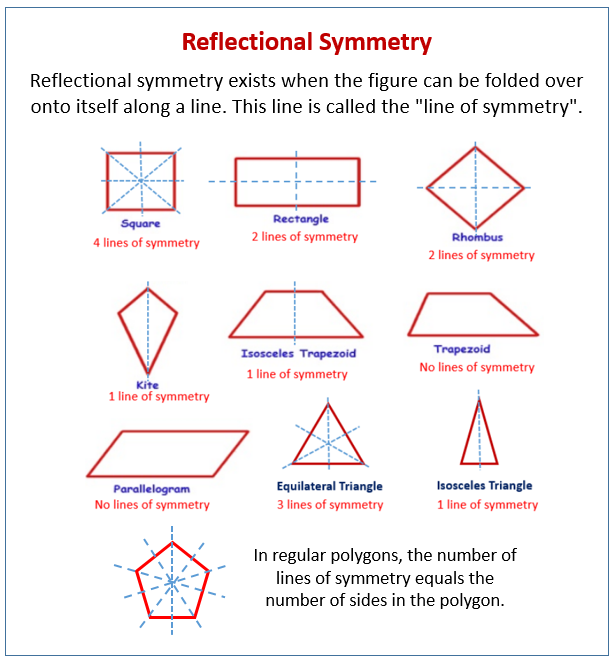
Symmetry in a figure exists if there is a reflection, rotation, or translation that can be performed and the image is identical. Reflectional symmetry exists when the figure can be folded over onto itself along a line. This line is called the "line of symmetry". In regular polygons, the number of lines of symmetry equals the number of sides in the polygon.How to identify and describe reflectional symmetry?
Rotational Symmetry
Symmetry in a figure exists if there is a reflection, rotation, or translation that can be performed and the image is identical. Rotational symmetry exists when the figure can be rotated and the image is identical to the original. Regular polygons have a degree of rotational symmetry equal to 360 divided by the number of sides.How to define rotational symmetry and identify the degree of rotational symmetry of common regular polygons? Rotational Symmetry, order of rotation and angle of rotation.
Dilations
A dilation is a non-rigid transformation, which means that the original and the image are not congruent. They are, however, similar figures. To perform dilations, a scale factor and a center of dilation are needed. If the scale factor is larger than 1, the image is larger than the original; if the scale factor is less than 1, the image is smaller than the original.How to perform and describe a dilation. Dilations. Basics and first part of an example. Dilations. Second part of the example, and scalar multiplication of matrices.
Glide Reflection
A glide reflection is a composition of transformations.In a glide reflection, a translation is first performed on the figure, then it is reflected over a line. Therefore, the only required information is the translation rule and a line to reflect over. A common example of glide reflections is footsteps in the sand.Try the free Mathway calculator and
problem solver below to practice various math topics. Try the given examples, or type in your own
problem and check your answer with the step-by-step explanations.

We welcome your feedback, comments and questions about this site or page. Please submit your feedback or enquiries via our Feedback page.