Sentence Patterns
In these lessons, we will learn the different ways of introducing the subject in a declarative sentence, basic sentence patterns and the types of sentence patterns.
Related Pages
Types of Sentences
Parts of Sentence
Parts of Speech
IELTS, TOEFL And English As A Second Language
More Lessons On English Grammar
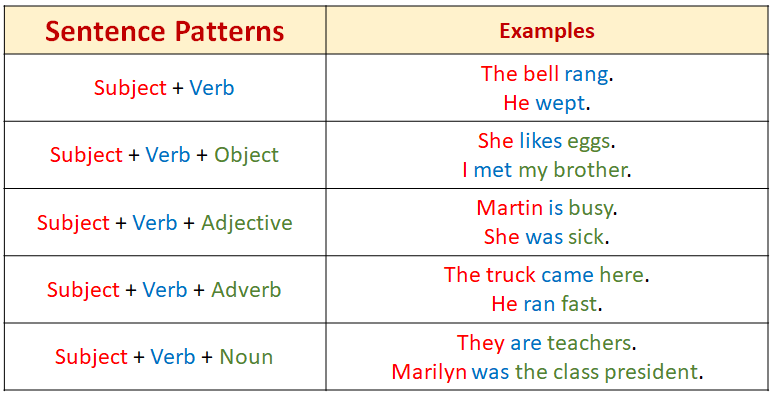
The following diagram gives some examples of sentence patterns. Scroll down the page for more examples of sentence patterns.
Declarative Sentence Pattern
A sentence must express a complete thought. It must also have both a subject and a predicate. It is possible to express a complete thought in a variety of ways.
Normal Order
There are a number of ways of introducing the subject in a declarative sentence. The normal order is subject first followed by the predicate. If we always followed this pattern, our sentences would soon become monotonous and uninteresting. This is illustrated by the following paragraph.
Example:
My friend gave me a book. It is a book about dogs. I enjoyed reading the book.
In the above paragraph, all the sentences follow the same pattern – subject first, followed by the predicate. We can give more variety to our sentence pattern by placing the words in different positions.
Inverted Order
We can put the subject after the verb or place it at the end of the sentence. This would be called inverted order.
Example:
In my bag, I found an interesting book about dogs. (The subject I
is placed after the group of words: In my bag.)
Down the street marched the band. (The subject band appears at the end of the sentence.)
Interrogative Sentence Pattern
The interrogative sentence is generally in inverted order. Sometimes the interrogative sentence starts with a verb. Often it begins with an adverb, which is used to answer the question.
Example:
Did you bring your books? (Starts with the verb did.)
Where did you buy this shirt? (Starts with the adverb where.)
Imperative And Exclamatory Sentence Patterns
In the imperative or exclamatory sentence, the subject is seldom expressed. If the subject is not expressed, the word you is implied.
Example:
Open the door now! (The subject you is implied.)
Please read the announcements. (The subject you is implied.)
Sentences That Begins With "There"
When the word "there" is used to introduce the sentence, it is possible to place the subject after the verb.
Example:
There was a heavy rainfall last night.
When the word there is used to introduce a sentence, it is called an expletive. The word expletive comes from Latin and it means ‘added merely to fill up’. The word there merely fills up the space normally occupied by the subject.
Basic English Grammar: Order In Sentences
Have you ever wondered what makes some writing more interesting than other writing?
Good writers vary the order in sentences.
Basic Sentence Patterns
Subject + Verb
Example:
Melissa reads.
She is eating.
Subject + Verb + Object
Example:
I like eggs.
She sees her sister.
Subject + Verb + Adjective
Example:
Laura is busy.
He is smart.
Subject + Verb + Adverb
Example:
Sarah is here.
Jack ran slowly.
Subject + Verb + Noun
Example:
She is my friend.
They are teachers.
Types Of Sentence Patterns
We will now look at 5 patterns in the English language.
Pattern 1 - Subject + Verb
Example:
Pauly waltzed onto the dancefloor.
She read.
The tired old woman cleaned often.
Pattern 2 - Subject + Verb + Direct Object
Example:
Pauly bought a new dress.
She read the book.
The old woman cleaned the drapes.
Pattern 3 - Subject + Verb + Direct Object + Indirect Object
Example:
Pauly bought her sister a new dress.
The old woman gave the pharmacy her prescription.
Pattern 4 - Subject + Linking Verb + Noun Complement
Example:
Melissa was the class president.
The boys were boy scouts.
Pattern 5 - Subject + Linking Verb + Adjective Complement
Example:
The house is very old.
I am very hungry.
Try the free Mathway calculator and
problem solver below to practice various math topics. Try the given examples, or type in your own
problem and check your answer with the step-by-step explanations.
We welcome your feedback, comments and questions about this site or page. Please submit your feedback or enquiries via our Feedback page.