Reflexive Pronouns
Welcome to our collection of English as a Second Language (ESL) tools & resources for students, teachers, and educators.
Related Pages
Types of Pronouns
Personal Pronouns
Subject Pronouns, Object Pronouns, Reflexive Pronouns
Possessive Pronouns
More Lessons On English Grammar
More Lessons for English as a Second Language
We have lots of free videos that will help you improve your English and also advice and tips that will help you in English proficiency examinations like TOEFL and IELTS.
A pronoun is a word that takes the place of a common noun or a proper noun.
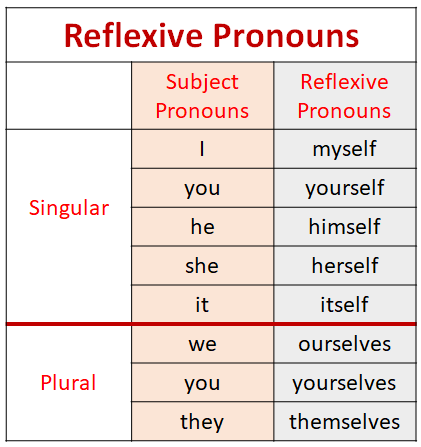
A reflexive pronoun is a pronoun that is usually used when the object of a sentence is the same as the subject. Each subject pronoun (such as I, you, he, she, it, we and they) has its own reflexive form.
The following diagram shows examples of reflexive pronouns. Scroll down the page for more examples of reflexive pronouns.
Reflexive pronouns may be used in several ways.
- When the subject and object in a sentence are the same.
Examples:
You are not to blame yourself. (subject is you, object is yourself)
The cat scratched itself. (subject is cat, object is itself)
You can come in and find yourselves a seat. (subject is you, object is yourselves)
- As the object of a preposition, when the subject and the object are the same.
He will go home by himself. (subject is he, object is himself, preposition is by)
Susan is looking at herself in the mirror. (subject is Susan, object is herself, preposition is at)
We completed the assignment all by ourselves. (subject is we, object is ourselves, preposition is by)
The noisy students draw attention to themselves. (subject is students, object is themselves, preposition is to)
- When you want to emphasize the subject.
I baked this myself. (no one else helped me)
He ate the pizza himself. (no one else had any)
Reflexive Pronouns
Reflexive pronouns refer the reader or listener back to the subject.
For example: “She looked at herself in the mirror. They gave themselves a lot of time to finish the work.”
Watch the following video for a lesson on reflexive pronouns.
Singular |
Subject Pronoun |
Reflexive Pronoun |
I |
myself |
|
you |
yourself |
|
he |
himself |
|
she |
herself |
|
it |
itself |
|
Plural |
you |
yourselves |
we |
ourselves |
|
they |
themselves |
Try the free Mathway calculator and
problem solver below to practice various math topics. Try the given examples, or type in your own
problem and check your answer with the step-by-step explanations.
We welcome your feedback, comments and questions about this site or page. Please submit your feedback or enquiries via our Feedback page.