

Rationalizing the Denominator
Related Topics:
More Lessons for Algebra
More Lessons and worksheets for Algebra
Review Rationalizing Denominator with Square Roots
A series of free, online or Algebra II lessons.
Examples, videos, solutions, worksheets, and activities to help Algebra students.
How to rationalize the denominator with a higher root.
Rationalize Denominators - Monomial Higher Roots
Rationalize the denominator containing a cube root
How to rationalize a denominator by multiplying by the conjugate. There will be times when you will need to rationalize the denominator and the denominator consists of a binomial radical. You need to multiply by the denominator's conjugate. Rationalizing Binomial Denominators Part 1 Rationalizing Binomial Denominators Part 2
How to solve an equation with a square root. Solving Radical Equations 1 Solving Radical Equations 2 Solving Radical Equations 3 Solving Radical Equations 4 Solving Radical Equations 5 Example of solving a Radical Equation that becomes a quadratic equation.
Shows how to solve a radical equation that has 2 radicals that after squaring both sides twice to eliminate both radicals produces a quadratic equation. Shows how to solve a radical equation that has 2 radicals that after squaring both sides twice to eliminate both radicals produces a quadratic equation.


More Lessons for Algebra
More Lessons and worksheets for Algebra
Review Rationalizing Denominator with Square Roots
A series of free, online or Algebra II lessons.
Examples, videos, solutions, worksheets, and activities to help Algebra students.
In this lesson, we will learn
- how to rationalize denominators with square roots
- how to rationalize denominators with higher roots
- how to rationalize denominators with a binomial
- how to solve radical equations
The following diagram how to rationalize the denominator using a conjugate when necessary. Scroll down the page for more examples and solutions rationalizing the denominator.
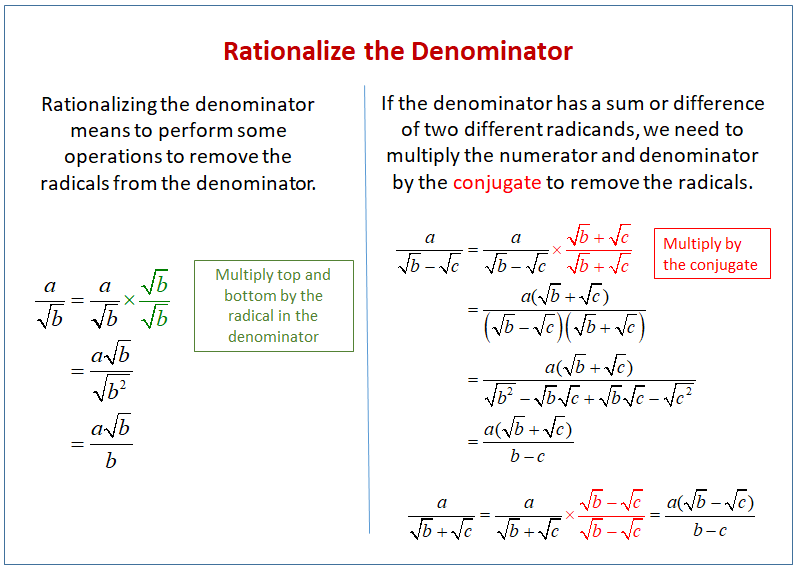
How to rationalize a denominator?
Rationalizing the Denominator with Higher Roots
When a denominator has a higher root, multiplying by the radicand will not remove the root. Instead, to rationalize the denominator we multiply by a number that will yield a new term that can come out of the root. For example, with a cube root multiply by a number that will give a cubic number such as 8, 27, or 64.How to rationalize the denominator with a higher root.
Rationalizing a Denominator with a Binomial
When rationalizing a denominator with two terms, called a binomial, first identify the conjugate of the binomial. The conjugate is the same binomial except the second term has an opposite sign. Next, multiply the numerator and denominator by the conjugate. The denominator becomes a difference of squares, which will eliminate the square roots in the denominator.How to rationalize a denominator by multiplying by the conjugate. There will be times when you will need to rationalize the denominator and the denominator consists of a binomial radical. You need to multiply by the denominator's conjugate. Rationalizing Binomial Denominators Part 1 Rationalizing Binomial Denominators Part 2
Solving an Equation with Radicals
Solving equations with radicals, no matter what power, involves isolating the radical on one side of the equation and then raising both sides of the equation to the power of the radical. When solving radicals, the final step is to isolate the variable. If there are more than one radical, we isolate and remove one root, then isolate and remove the other root. Finally, we solve the remaining equation for the variable.How to solve an equation with a square root. Solving Radical Equations 1 Solving Radical Equations 2 Solving Radical Equations 3 Solving Radical Equations 4 Solving Radical Equations 5 Example of solving a Radical Equation that becomes a quadratic equation.
Shows how to solve a radical equation that has 2 radicals that after squaring both sides twice to eliminate both radicals produces a quadratic equation. Shows how to solve a radical equation that has 2 radicals that after squaring both sides twice to eliminate both radicals produces a quadratic equation.
Try the free Mathway calculator and
problem solver below to practice various math topics. Try the given examples, or type in your own
problem and check your answer with the step-by-step explanations.

We welcome your feedback, comments and questions about this site or page. Please submit your feedback or enquiries via our Feedback page.