Possessive Nouns
In these lessons, we will learn
- how to use possessive nouns
- the rules for forming possessive nouns
- possessive singular nouns and possessive plural nouns
Related Pages
Possessive Pronouns
Gender Nouns
Proper Nouns
More Lessons On English Grammar
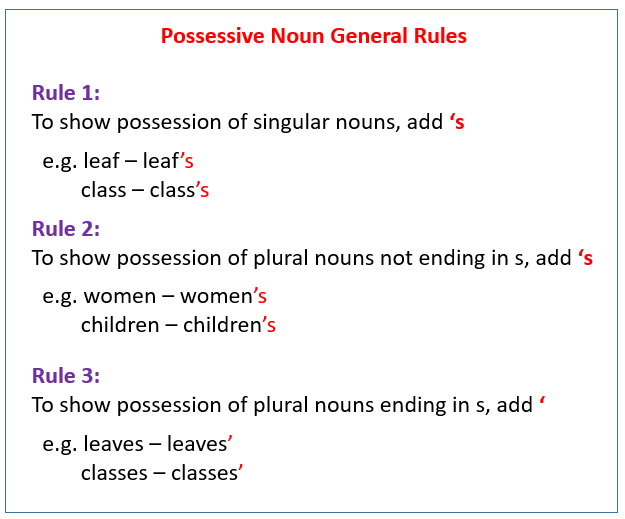
The following diagram gives some general rules for possessive nouns. Scroll down the page for more examples and rules.
What are Possessive Nouns?
Possessive nouns are nouns that show “relationships”
- Possessive nouns can be used to show ‘belonging to’ or ‘ownership’.
Examples:
This is Jill’s house. (Jill owns the house)
They were not able to find Paul’s shoes. (The shoes belong to Paul)
The cat’s dish is empty.
The lamp’s base is broken.
- Possessive nouns can show where someone works or studies or spends time.
Examples:
I went to Jack’s school.
Put this box in Colin’s office.
- Possessive nouns can indicate family relationships.
Examples:
Gordon’s mother is a dentist.
He went with Brian’s brother.
General Rules for Forming Possessive Nouns
Rule 1:
Add an apostrophe s (‘s) to form the possessive of
singular nouns. This rule also applies to singular nouns ending in
s.
Examples:
| Singular Nouns | Possessive Nouns |
| lamp | lamp’s |
| egg | egg’s |
| branch | branch’s |
| mango | mango’s |
| Paul | Paul’s |
| Simon | Simon’s |
| goose | goose’s |
| woman | woman’s |
| leaf | leaf’s |
| lady | lady’s |
| bus | bus’s |
| class | class’s |
Rule 2:
Add an apostrophe s (‘s) to form the possessive of
plural nouns that do not end with s.
Examples:
| Plural Nouns | Possessive Nouns |
| geese | geese’s |
| oxen | oxen’s |
| women | women’s |
| children | children’s |
Rule 3:
Add an apostrophe (‘) to form the possessive of
plural nouns that end with s.
Examples:
| Plural Nouns | Possessive Nouns |
| lamps | lamps’ |
| eggs | eggs’ |
| branches | branches’ |
| mangoes | mangoes’ |
| leaves | leaves’ |
| ladies | ladies’ |
| buses | buses’ |
| classes | classes’ |
Rule 4:
For the names of people that end with s, add an apostrophe s (‘s)
or apostrophe (‘). (Both methods are acceptable.)
Examples:
| Names of People that ends with s | Possessive Nouns |
| Phyllis | Phyllis’s or Phyllis’ |
| Thomas | Thomas’s or Thomas’ |
| Jones | Jones’s or Jones’ |
Rule 5:
Add an apostrophe s (‘s) or apostrophe (‘) to the end of a compound noun.
Examples:
| Compound Noun | Possessive Noun |
| classroom | classroom’s |
| classrooms | classrooms’ |
| fire engine | fire engine’s |
| fire engines | fire engines’ |
| son-in-law | son-in-law’s |
| son-in-laws | son-in-laws’ |
The position of the apostrophe in a noun (to indicate possession of something) often causes problems for learners. The following video explains the rules for singular and plural possessive nouns.
Possessive Nouns for Kids
Captain Cluck explains apostrophe ‘S.’
Possessive Nouns.
Possessive Singular Nouns and Possessive Plural Nouns
Separate and Joint ownership.
Grammar Tips: Possessive Noun
Here’s how to use the apostrophe to make nouns possessive. It’s really not difficult once you
memorize the few simple rules in this video.
This video shows how to use possessive nouns - singular and plural.
Try the free Mathway calculator and
problem solver below to practice various math topics. Try the given examples, or type in your own
problem and check your answer with the step-by-step explanations.
We welcome your feedback, comments and questions about this site or page. Please submit your feedback or enquiries via our Feedback page.