

Laplace Transform
Related Topics:
Calculus
Math Worksheets
A series of free Calculus Videos. How to calculate a Laplace Transform?
Calculating a Laplace Transform
The definition of the Laplace Transform and use it to find the Laplace Transform of f(t) = et.
Laplace Transform: First Shifting Theorem
Calculate the Laplace transform of a particular function via the "first shifting theorem". This video may be thought of as a basic example. The first shifting theorem is a useful tool when faced with the challenge of taking the Laplace transform of the product of exponential function with another function. The Laplace transform is very useful in solving ordinary differential equations.
Laplace Transform: Second Shifting Theorem
Calculate the Laplace transform of a particular function via the "second shifting theorem". This video may be thought of as a basic example. The second shifting theorem is a useful tool when faced with the challenge of taking the Laplace transform of the product of a shifted unit step function (Heaviside function) with another shifted function. The Laplace transform is very useful in solving ordinary differential equations.
Laplace Transform of $tf(t)$
The video presents a simple proof of an result involving the Laplace transform of $tf(t)$. In particular it is shown that the Laplace transform of $tf(t)$ is $-F'(s)$, where $F(s)$ is the Laplace transform of $f(t)$. The proof involves an application of Leibniz rule for differentiating integrals. Laplace transforms find important applications in solving ordinary differential equations with discontinuities


Calculus
Math Worksheets
A series of free Calculus Videos. How to calculate a Laplace Transform?
Calculating a Laplace Transform
The definition of the Laplace Transform and use it to find the Laplace Transform of f(t) = et.
Calculate the Laplace transform of a particular function via the "first shifting theorem". This video may be thought of as a basic example. The first shifting theorem is a useful tool when faced with the challenge of taking the Laplace transform of the product of exponential function with another function. The Laplace transform is very useful in solving ordinary differential equations.
Calculate the Laplace transform of a particular function via the "second shifting theorem". This video may be thought of as a basic example. The second shifting theorem is a useful tool when faced with the challenge of taking the Laplace transform of the product of a shifted unit step function (Heaviside function) with another shifted function. The Laplace transform is very useful in solving ordinary differential equations.
The video presents a simple proof of an result involving the Laplace transform of $tf(t)$. In particular it is shown that the Laplace transform of $tf(t)$ is $-F'(s)$, where $F(s)$ is the Laplace transform of $f(t)$. The proof involves an application of Leibniz rule for differentiating integrals. Laplace transforms find important applications in solving ordinary differential equations with discontinuities
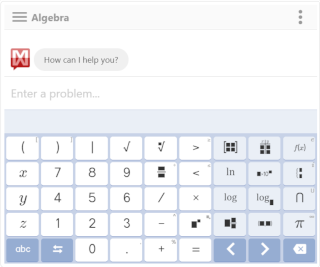
Try the free Mathway calculator and
problem solver below to practice various math topics. Try the given examples, or type in your own
problem and check your answer with the step-by-step explanations.
We welcome your feedback, comments and questions about this site or page. Please submit your feedback or enquiries via our Feedback page.