Horizontal and Vertical Graph Transformations
Examples, solutions, videos, worksheets, and activities to help PreCalculus students learn about horizontal and vertical graph transformations.
How to graph horizontal and vertical stretches and compressions?
Vertical Stretch and Vertical Compression
y = af(x), a > 1, will stretch the graph f(x) vertically by a factor of a.
y = af(x), 0 < a < 1, will stretch the graph f(x) vertically by a factor of a.
Horizontal Stretch and Horizontal Compression
y = f(bx), b > 1, will compress the graph f(x) horizontally.
y = f(bx), 0 < b < 1, will stretch the graph f(x) horizontally.
How to graph horizontal and vertical translations?
Horizontal Shift
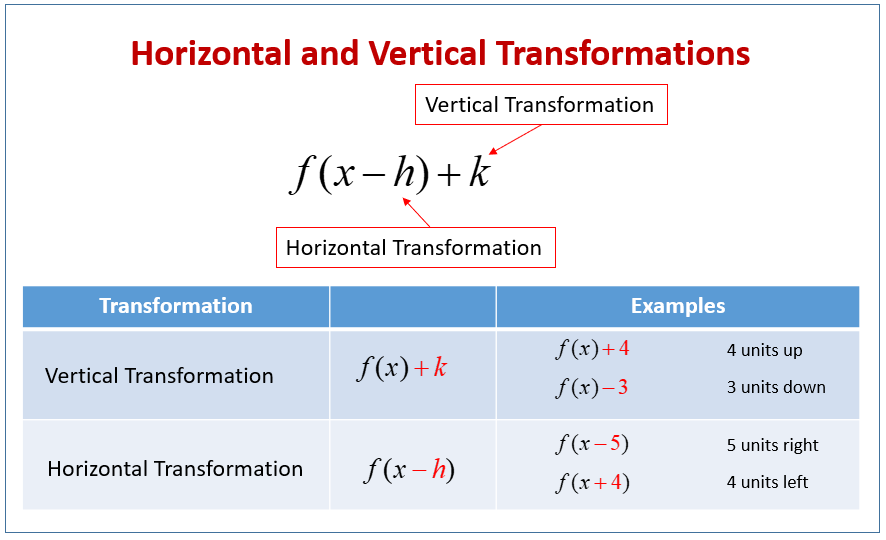
y = f(x + c), will shift f(x) left c units.
y = f(x - c), will shift f(x) right c units.
Vertical Shift
y = f(x) + d, will shift f(x) up d units.
y = f(x) - d, will shift f(x) down d units.<
The following diagrams show horizontal and vertical transformations of functions and graphs. Scroll down the page for more examples and solutions on horizontal and vertical transformations.
Function Transformations: Horizontal and Vertical Stretches and Compressions
This video explains how to graph horizontal and vertical stretches and compressions in the form a×f(b(x-c))+d.
This video looks at how a and b affect the graph of f(x).
Function Transformations: Horizontal and Vertical Translations
This video explains how to graph horizontal and vertical translation in the form a*f(b(x-c))+d. This video looks at how c and d affect the graph of f(x).
Functions Transformations: A Summary
This video reviews function transformation including stretches, compressions, shifts left, shifts right, and reflections across the x and y axes.
Horizontal and Vertical Graph Transformations
9 full examples as well as the basic outline of doing horizontal and vertical translations of graphs are shown.
Try the free Mathway calculator and
problem solver below to practice various math topics. Try the given examples, or type in your own
problem and check your answer with the step-by-step explanations.

We welcome your feedback, comments and questions about this site or page. Please submit your feedback or enquiries via our Feedback page.