Graphing Radical Equations
Examples, solutions, videos, worksheets, games, and activities to help Algebra 1 students learn how to graph radical equations.
In these lessons, we will learn how to graph radical equations or radical functions by plotting points or by using shifts and transformations.
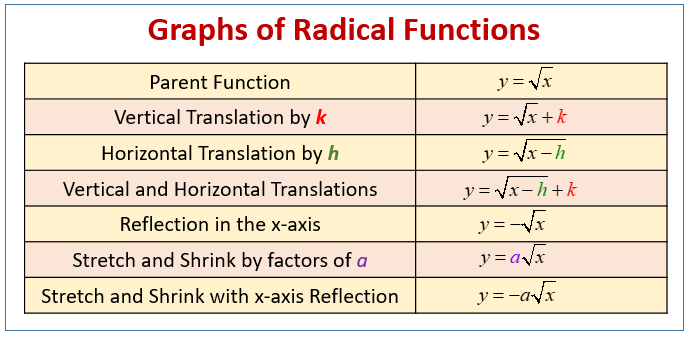
The following diagram shows a summary of Radical Function Transformations. Scroll down the page for more examples and solutions of graphs of radical functions.
Graphing Radical Equations using a Table or Plotting Points
One way to graph radical functions is to create a table of values and then plot the points. Before starting the table, first determine the domain of the function. Remember, the radical must be greater than or equal to zero. Once this lower limit for input (domain) values is established, create the table of values. When graphing radicals we plot the points in the coordinate plane.
This video is a demonstration of graphing radical equations by first (1) finding the domain, and (2) using an x-y table.
Graphing radical equations.
Graphing Radical Equations using Shifts or Transformations
When graphing radical equations using shifts:
Adding or subtracting a constant that is not in the radical will shift the graph up (adding) or down (subtracting).
Adding or subtracting a constant that is in the radical will shift the graph left (adding) or right (subtracting).
Multiplying a negative constant by the equation will reflect the graph over the x-axis. Multiplying by a number larger than one increases the y-values.
Graphs of Radical Functions: This video will teach you how to graph radical functions and their translations.
Graphing Radicals using Vertical/Horizontal shifts and scaling.
Graphing Radical Functions.
Graphing Radical Functions - square root function and cube root function.
Graphing Radical Functions
y = sqrt(x) + 3
y = sqrt(x) - 3
y = cuberoot(x) + 2
y = cuberoot(x) - 2
y = sqrt(x + 4)
y = sqrt(x - 4)
y = cuberoot(x + 5)
y = cuberoot(x - 5)
y = sqrt(x - 3) + 5
Graphing Square Root and Other Radical Functions.
Try the free Mathway calculator and
problem solver below to practice various math topics. Try the given examples, or type in your own
problem and check your answer with the step-by-step explanations.
We welcome your feedback, comments and questions about this site or page. Please submit your feedback or enquiries via our Feedback page.