Factor Theorem
In these lessons, we will look at the Factor Theorem and how it relates to the Remainder Theorem. We will also show how to factor polynomials using the Factor Theorem.
Related Pages
Remainder Theorem
Solving Cubic Equations
Remainder And Factor Theorems
More Algebra Lessons
Remainder Theorem And Factor Theorem
What Is The Factor Theorem?
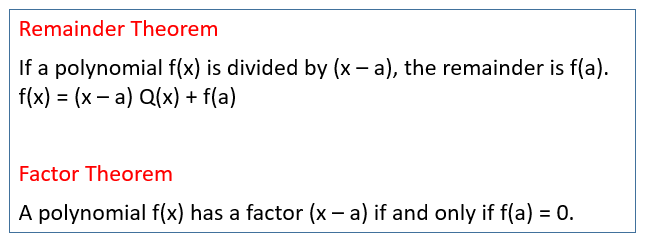
When f(x) is divided by (x – a), we get
f(x) = (x – a)Q(x) + remainder
From the Remainder Theorem we get
f(x) = (x – a)Q(x) + f(a)
If f(a) = 0 then the remainder is 0 and
f(x) = (x – a)Q(x)
We can then say that (x – a) is a factor of f(x)
The Factor Theorem states that
(x – a) is a factor of the polynomial f(x) if and only if f(a) = 0
Take note that the following statements are equivalent for any polynomial f(x).
- (x – a) is a factor of f(x).
- The remainder is zero when f(x) is divided by (x – a).
- f(a) = 0.
- The solution to f(x) = 0 is a.
- The zero of the function f(x) is a.
Example:
Determine whether x + 1 is a factor of the following polynomials.
a) 3x4 + x3 – x2 + 3x + 2
b) x6 + 2x(x – 1) – 4
Solution:
a) Let f(x) = 3x4 + x3 – x2 + 3x + 2
f(–1) = 3(–1)4 + (–1)3 – (–1)2 +3(–1) + 2
= 3(1) + (–1) – 1 – 3 + 2 = 0
Therefore, x + 1 is a factor of f(x)
b) Let g(x) = x6 + 2x(x – 1) – 4
g(–1) = (–1)6 + 2(–1)( –2) –4 = 1
Therefore, x + 1 is not a factor of g(x)
How To Use The Factor Theorem And Remainder Theorem?
What the theorems are and how they can be used to find the linear factorization of a polynomial?
The Remainder Theorem states that if a polynomial, f(x), is divided by x - k, the remainder is equal to f(k).
The Factor Theorem states that the polynomial x - k is a factor of the polynomial f(x) if and only if f(k) = 0.
Example:
Let f(x) = 2x3 − 3x2 − 5x + 6
Is x - 1 a factor?
Find all the other factors.
How To Use The Factor Theorem To Factor Polynomials?
Examples:
-
Factor P(x) = 3x3 − x2 − 19x + 8
-
Factor P(x) = 2x3 − 9x2 + x + 12
How To Find Remaining Factors Of A Polynomial?
A lesson on the factor theorem and completely factoring a polynomial.
- To learn the connection between the factor theorem and the remainder theorem.
- To learn how to use the factor theorem to determine if a binomial is a factor of a given polynomial or not.
- To use synthetic division, along with the factor theorem to help factor a polynomial.
Example:
Fully factor x4 − 3x3 − 7x2 + 15x + 18
Application Of The Factor Theorem
How to use the factor theorem to determine if x - c is a factor of the polynomial f?
Examples:
- f(x) = 4x3 - 3x2 - 8x + 4, c = 3
- f(x) = 3x4 - 6x3 - 5x + 10, c = 1
- f(x) = 3x6 + 2x3 - 176, c = -2
- f(x) = 4x6 - 64x4 - x2 - 16, c = 4
- f(x) = 2x4 - x3 - 2x - 1, c = -1/2
How To Explain The Factor Theorem?
If f(x) is a polynomial and f(p) = 0 then (x − p) is a factor of f(x)
If f(x) is a polynomial and f(−q) = 0 then (x + q) is a factor of f(x)
Description And Examples Of The Factor Theorem
Examples:
Prove that (x + 1) is a factor of P(x) = x2 + 2x + 1
Is (x + 2) a factor of x3 + 4x2 − x − 3?
Try the free Mathway calculator and
problem solver below to practice various math topics. Try the given examples, or type in your own
problem and check your answer with the step-by-step explanations.

We welcome your feedback, comments and questions about this site or page. Please submit your feedback or enquiries via our Feedback page.