Introduction to Logarithmic Functions
In this lesson, we will look at what are logarithms and the relationship between exponents and logarithms.
Logarithms can be considered as the inverse of exponents (or indices).
Definition of Logarithm
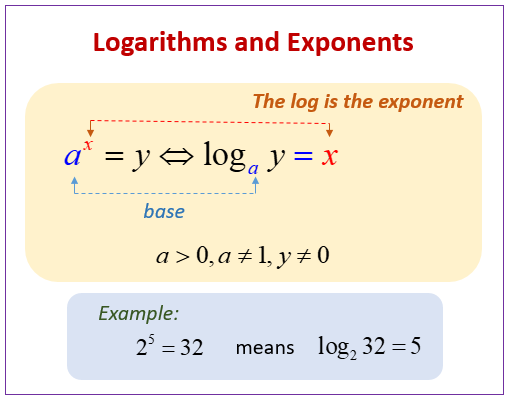
If ax = y such that a > 0, a ≠ 1 then loga y = x
ax = y ↔ loga y = x
Exponential Form
y = ax
Logarithmic Form
loga y = x
Remember: The logarithm is the exponent.
The following diagram shows the relationship between logarithm and exponent. Scroll down the page for more examples and solutions for logarithms and exponents.
Example:
Convert the following exponential form to the logarithmic form:
a) 42 = 16
b) 25 = 32
c) 
Solution:
a) 42 = 16
2 = log4 16 (the log is the exponent)
b) 25 = 32
5 = log2 32

Example:
Convert the following logarithmic form to exponential form
a) 3 = log2 8
b) 2 = log5 25
c) 
Solution:
a) 3 = log2 8
23 = 8
b) 2 = log5 25
52 = 25

Take note of the following:
- Since a1 = a, loga a = 1
- Since a0 = 1, loga 1 = 0
- Log*a* 0 is undefined
- Logarithms of negative numbers are undefined.
- The base of logarithms can be any positive number except 1.
- Logarithms to the base 10 are known as common logarithms and are represented by log10 or log.
- Logarithms to the base e are known as natural logarithms and are represented by loge or ln.
Function Notation with Logs and Exponentials
Function notation is used frequently in science to express functions that contain logs and exponents. We learn to use function notation with logs and exponentials in order to solve problems such as computing compounding interest. We can solve these problems written in function notation with logs and exponentials using techniques from solving exponential and log equations.
Logarithm - Solving log & exponent equations
This video provides an introduction to solving logarithmic and exponential equations. A methodology is introduced so that students will have some type of basic strategy for solving these types of equations.
Try the free Mathway calculator and
problem solver below to practice various math topics. Try the given examples, or type in your own
problem and check your answer with the step-by-step explanations.
We welcome your feedback, comments and questions about this site or page. Please submit your feedback or enquiries via our Feedback page.