Derivatives of Exponential Functions
These lessons look at the exponential derivatives.
Related Pages
Exponential Functions
Derivative Rules
Natural Logarithm
Calculus Lessons
The function f(x) = 2x is called an exponential function because the variable x is the variable. Do not confuse it with the function g(x) = x2, in which the variable is the base.
The following diagram shows the derivatives of exponential functions. Scroll down the page for more examples and solutions on how to use the derivatives of exponential functions.
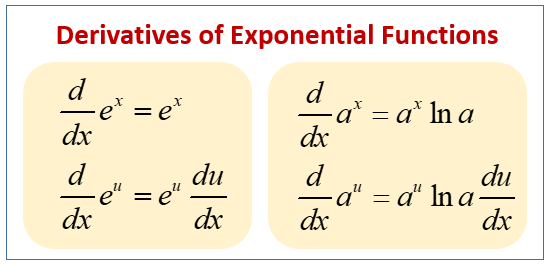
In general, an exponential function is of the form
f(x) = ax where a is a positive constant.
Derivative of the Natural Exponential Function

The exponential function f(x) = ex has the property that it is its own derivative. This means that the slope of a tangent line to the curve y = ex at any point is equal to the y-coordinate of the point.
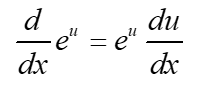
We can combine the above formula with the chain rule to get
Example:
Differentiate the function y = e sin x
Solution:

Example:
Differentiate the function y = e–3xsin4x
Solution:
Using the Product Rule and the above formulas, we get

Derivative of ax

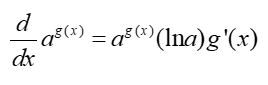
Derivative of ag(x)
Example:
Differentiate y = x3 + 3x
Solution:

Example:
Differentiate y = 52x+1
Solution:

Derivatives of Exponential Functions
The derivative of an exponential function can be derived using the definition of the derivative.
Derivatives of exponential functions involve the natural logarithm function, which itself is an
important limit in Calculus, as well as the initial exponential function. The derivative is the
natural logarithm of the base times the original function.
Derivatives of Exponential Functions with Base e
Exponential Functions and Derivatives
This video gives the formula to find derivatives of exponential functions and does a few
examples of finding derivatives of exponential functions.
Try the free Mathway calculator and
problem solver below to practice various math topics. Try the given examples, or type in your own
problem and check your answer with the step-by-step explanations.
We welcome your feedback, comments and questions about this site or page. Please submit your feedback or enquiries via our Feedback page.