The Conjunction
Welcome to our collection of English tools and resources for students, teachers, and educators.
A conjunction joins words or groups of words.
There are three kinds of conjunctions:
- Coordinating conjunctions
- Correlative conjunctions
- Subordinating conjunctions
Coordinating Conjunctions
Some of the commonly used coordinating conjunctions are:
for, and, nor, but, or, yet, so
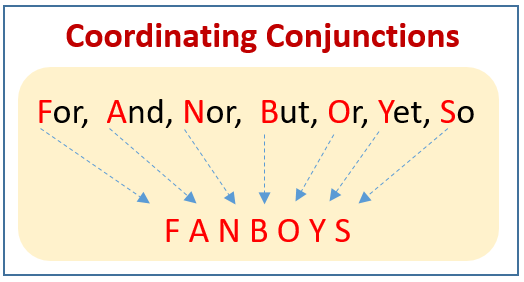
We can use the mnemonics FANBOYS to help us remember the coordinating conjunctions.
The following diagram gives the coordinating conjunctions: for, and, nor, but, or, yet, so (FANBOYS). Scroll down the page for more examples and solutions.
Coordinating conjunctions may join single words, or they may join groups of words. They always connect items of the same kind and come between the words or clauses that they join.
Examples:
table and chairs (connect two nouns)
in the cupboard or on the table (connect two prepositional phrases)
It was raining, so I had to stay indoors. (connect two complete ideas or independent clauses)
When a coordinating conjunction joins independent clauses, it is always correct to place a comma before the conjunction:
Examples:
I prefer coffee, but my sister prefers tea.
I don’t like running, nor do I like football.
Correlative Conjunctions
Correlative conjunctions also connect items of the same kind. However, unlike coordinating conjunctions, correlative conjunctions are always used in pairs.
Some of the commonly used correlative conjunctions are:
both…and
either…or
neither…nor
not only…but also
so…as
whether…or
if … then
Examples:
Both Paul and Sam played football in high school.
Either you must clean the room or you will have to wash the dishes.
Famous quotes that use correlative conjunctions:
“To accomplish great things, we must not only act, but also dream; not only plan, but also believe.” (Anatole France)
“Education is not the filling of a pail, but the lighting of a fire.” (William Butler Yeats)
“The fascination of shooting as a sport depends almost wholly on whether you are at the right or wrong end of the gun.” (P. G. Wodehouse)
“Neither the life of an individual nor the history of a society can be understood without understanding both.” (C. Wright Mills)
“In the end, we will remember not the words of our enemies, but the silence of our friends.” (Martin Luther King, Jr.)
Subordinate Conjunctions
A subordinate conjunction joins a subordinate clause to a main clause.
A main clause or independent clause is a clause that can stand alone as a complete sentence.
A subordinate clause or dependent clause does not express a complete idea. It must be attached to a main clause to complete its meaning.
Examples:
Since it was cold, I wore my coat. (I wore my coat is the main clause. Since it was cold is the subordinate clause).
Some of the commonly used subordinate conjunctions are:
after |
before |
unless |
What is a Conjunction?
Coordinate Conjunctions
Correlative Conjunctions
Subordinate Conjunctions
Try the free Mathway calculator and
problem solver below to practice various math topics. Try the given examples, or type in your own
problem and check your answer with the step-by-step explanations.
We welcome your feedback, comments and questions about this site or page. Please submit your feedback or enquiries via our Feedback page.