Conditional Probability
In these lessons, we will learn what is conditional probability and how to use the formula for conditional probability.
Related Pages
Dependent Events
More Lessons On Probability
Probability Tree Diagrams
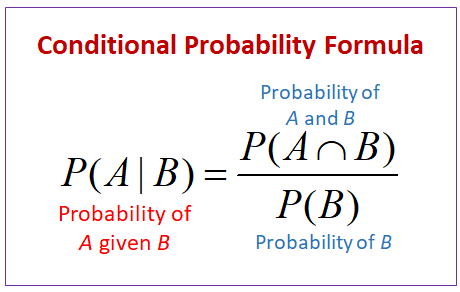
The following diagram shows the formula for conditional probability. Scroll down the page for more examples and solutions on finding the conditional probability.
What Is Conditional Probability?
The probability of an event occurring given that another event has already occurred is called a conditional probability.
Recall that when two events, A and B, are dependent, the probability of both occurring is:
P(A and B) = P(A) × P(B given A)
or P(A and B) = P(A) × P(B | A)
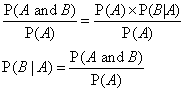
If we divide both sides of the equation by P(A) we get the
Formula for Conditional Probability
How To Find The Conditional Probability From A Word Problem?
Step 1: Write out the Conditional Probability Formula in terms of the problem
Step 2: Substitute in the values and solve.
Example:
Susan took two tests. The probability of her passing both tests is 0.6. The probability of her
passing the first test is 0.8. What is the probability of her passing the second test given that
she has passed the first test?
Solution:

Example:
A bag contains red and blue marbles. Two marbles are drawn without replacement. The probability of
selecting a red marble and then a blue marble is 0.28. The probability of selecting a red marble
on the first draw is 0.5. What is the probability of selecting a blue marble on the second draw,
given that the first marble drawn was red?
Solution:

Solution:
What is the probability that the total of two dice will be greater than 9, given that the first die is a 5?
Solution:
Let A = first die is 5
Let B = total of two dice is greater than 9
P(A) = 
Possible outcomes for A and B: (5, 5), (5, 6)
P(A and B) = 

How To Use Real World Examples To Explain Conditional Probability?
Conditional probability is about narrowing down the set of possible circumstances so that the statistics can be measured more accurately.
How To Define Conditional Probability?
This video introduces the basic definition of conditional probability as it is defined in standard probability theory.
How To Calculate Conditional Probability?
Tutorial on how to calculate conditional probability for two events P(A), P(B), P(B|A) with two examples.
- Example 1: What is the probability of rolling a dice and its value is less than 4 knowing that the value is an odd number?
- Example 2: What is the probability of rolling a dice and its value is 1 knowing that the value is an odd number?
How To Determine The Conditional Probability From The Given Word Problems?
Examples:
- You roll one 6-sided die, what is the probability of a 3 given you know the number is odd?
- At P-Town High School, the probability that a student takes Computer Programming and Spanish is
0.15. The probability that a student takes Computer Programming is 0.4.
What is the probability that a student takes Spanish given that the student is taking Computer Programming? - Here are the results of a survey completed with adult parents with children. What is the probability a person thinks college is too expensive given they have a child in college?
- Two cards are drawn without replacement in succession. What is the probability that the second card drawn is an ace, given that the first can drawn was an ace?
- Two cards are drawn without replacement. What is the probability the second card is a red face card given the first card is a ref face card?
Try the free Mathway calculator and
problem solver below to practice various math topics. Try the given examples, or type in your own
problem and check your answer with the step-by-step explanations.

We welcome your feedback, comments and questions about this site or page. Please submit your feedback or enquiries via our Feedback page.