Composite Functions
Related Pages
Math Functions
Composite Functions
Lessons with videos, examples and solutions looking at the composition of functions or composite functions.
What Is A Composite Function?
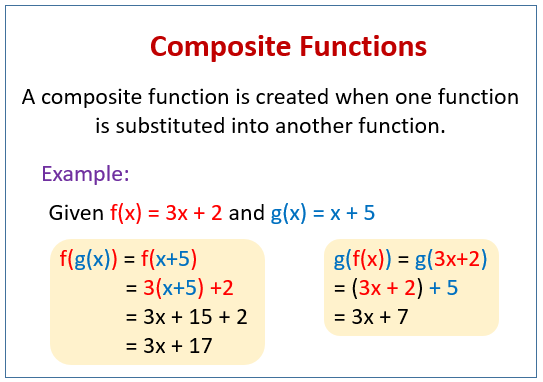
A composite function is a function that depends on another function. A composite function is created when one function is substituted into another function.
For example, f(g(x)) is the composite function that is formed when g(x) is substituted for x in f(x).
f(g(x)) is read as “f of g of x”.
f(g(x)) can also be written as (f ∘ g)(x) or fg(x),
In the composition (f ∘ g)(x), the domain of f becomes g(x).
The following diagram shows some examples of composite functions. Scroll down the page for more examples and solutions.
Example:
Given f(x) = x2 + 6 and g(x) = 2x – 1, find
a) (f ∘ g)(x)
b) (g ∘ f)(x)
Solution:
a) (f ∘ g)(x)
= f(2x – 1)
= (2x – 1)2 + 6
= 4x2 – 4x + 1 + 6
= 4x2 – 4x + 7
b) (g ∘ f)(x)
= g(x2 + 6)
= 2(x2 + 6) – 1
= 2x2 + 12 – 1
= 2x2 + 11
Composite Functions
This lesson explains the concept of composite functions. An example is given demonstrating how to work algebraically with composite functions and another example involves an application that uses the composition of functions.
Examples:
- If f(x) = x + 5 and g(x) = 3x2 find
(a) (f ∘ g)(x)
(b) (f ∘ g)(2)
(c) g(f(x)) - A newspaper company creates routes with 50 subscribers(n) for each delivery person(d). There is a supervisor (s) for every 10 delivery persons.
(a) Write d as a function of n.
(b) Write s as a function of d.
(c) Substitute to write s as a function of n.
How To Determine The Value Of A Composite Function And How To Determine A Composite Function Given Two Functions?
Examples:
- Given the functions, determine the value of each composite function.
f(x) = 2x - 1, g(x) = x3 - 5, h(x) = 5 - x2
(a) (f ∘ g)(3)
(b) (g ∘ f)(3)
(c) (h ∘ g)(-1) - Given the functions, determine the value of each composite function.
f(x) = 4x + 1, g(x) = x2 - x + 5
(a) (f ∘ g)(x)
(b) (g ∘ f)(x)
How To Find The Composition Of Functions?
Example:
f(x) = x2 + x and g(x) = 4 - x
Find
(a) (f ∘ g)(x)
(b) (g ∘ f)(x)
What Is The Composition Of Two Functions?
Example:
f(x) = 2x4 + x4 + 1, g(x) = √x
Find f(g(x))
Try the free Mathway calculator and
problem solver below to practice various math topics. Try the given examples, or type in your own
problem and check your answer with the step-by-step explanations.

We welcome your feedback, comments and questions about this site or page. Please submit your feedback or enquiries via our Feedback page.