Combinations
In these lessons, we will learn the concept of combinations, the combination formula and solving problems involving combinations.
Related Pages
Permutations
Permutations and Combinations
Counting Methods
Factorial Lessons
Probability
What Is Combination In Math?
An arrangement of objects in which the order is not important is called a combination. This is different from permutation where the order matters. For example, suppose we are arranging the letters A, B and C. In a permutation, the arrangement ABC and ACB are different. But, in a combination, the arrangements ABC and ACB are the same because the order is not important.
What Is The Combination Formula?
The number of combinations of n things taken r at a time is written as C(n, r).
The following diagram shows the formula for combination. Scroll down the page for more examples and solutions on how to use the combination formula.
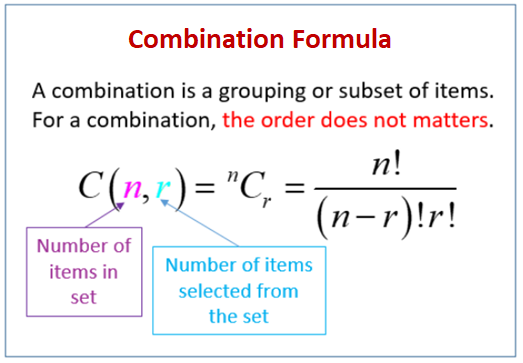
If you are not familiar with the n! (n factorial notation) then have a look the factorial lesson
How To Use The Combination Formula To Solve Word Problems?
Example:
In how many ways can a coach choose three swimmers from among five swimmers?
Solution:
There are 5 swimmers to be taken 3 at a time.
Using the formula:
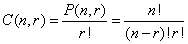

The coach can choose the swimmers in 10 ways.
Example:
Six friends want to play enough games of chess to be sure every one plays everyone else. How
many games will they have to play?
Solution:
There are 6 players to be taken 2 at a time.
Using the formula:

They will need to play 15 games.
Example:
In a lottery, each ticket has 5 one-digit numbers 0-9 on it.
a) You win if your ticket has the digits in any order. What are your changes of winning?
b) You would win only if your ticket has the digits in the required order. What are your
chances of winning?
Solution:
There are 10 digits to be taken 5 at a time.
a) Using the formula:

The chances of winning are 1 out of 252.
b) Since the order matters, we should use permutation instead of combination.
P(10, 5) = 10 x 9 x 8 x 7 x 6 = 30240
The chances of winning are 1 out of 30240.
How To Evaluate Combinations As Well As Solve Counting Problems Using Combinations?
A combination is a grouping or subset of items. For a combination, the order does not matter.
How many committees of 3 can be formed from a group of 4 students?
This is a combination and can be written as C(4,3) or 4C3
or \(\left( {\begin{array}{*{20}{c}}4\\3\end{array}} \right)\).
Examples:
- The soccer team has 20 players. There are always 11 players on the field. How many different groups of players can be on the field at any one time?
- A student need 8 more classes to complete her degree. If she met the prerequisites for all the courses, how many ways can she take 4 classes next semester?
- There are 4 men and 5 women in a small office. The customer wants a site visit from a group of 2 man and 2 women. How many different groups can be formed from the office?
How To Solve Word Problems Involving Permutations And Combinations?
Examples:
- A museum has 7 paintings by Picasso and wants to arrange 3 of them on the same wall. How many ways are there to do this?
- How many ways can you arrange the letters in the word LOLLIPOP?
- A person playing poker is dealt 5 cards. How many different hands could the player have been dealt?
How To Solve Combination Problems That Involve Selecting Groups Based On Conditional Criteria?
Example: A bucket contains the following marbles: 4 red, 3 blue, 4 green, and 3 yellow making 14 total marbles. Each marble is labeled with a number so they can be distinguished.
- How many sets/groups of 4 marbles are possible?
- How many sets/groups of 4 are there such that each one is a different color?
- How many sets of 4 are there in which at least 2 are red?
- How many sets of 4 are there in which none are red, but at least one is green?
Try the free Mathway calculator and
problem solver below to practice various math topics. Try the given examples, or type in your own
problem and check your answer with the step-by-step explanations.
We welcome your feedback, comments and questions about this site or page. Please submit your feedback or enquiries via our Feedback page.