Animal Facts: Blue-Tongued Lizards, Chow Chow, Giraffes
In this page we will look at the blue-tongued lizards, chow chow dogs and giraffes.
If you have any interesting or funny facts about animals or would like to find out more information about a particular animal, please fill up the Feedback form and we will be happy to add it to our list of animal facts.
What animals have blue tongues?
A blue-tongued lizard, obviously.
The Western Blue-tongued Lizard, (also known as the Western Blue-tongued Skink) is a variety of large skink native to Australia. The Western Blue-tongued Lizard is one of six species of blue-tongued lizard found in Australia, though further species are found in New Guinea and Indonesia.
The lizard grows to around 45 cm (17¾ in) in length. It has a brown striped pattern across the body and tail; the underside of the body is usually pale. It has distinctive black markings across each eye. The body is wide and large in comparison to the size of the legs. As its name suggests, it has a blue tongue, which contrasts with the pink interior of its mouth. When threatened, it may open its mouth and stick out its tongue in a threat display. If the initial display is unsuccessful, and the predator or threat does not retreat, it may hiss and flatten out its body in an attempt to make itself look bigger.
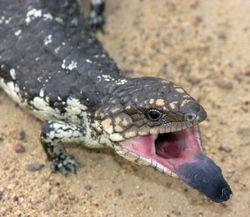
It is diurnal (awake during the day), hunting for insects, spiders, and snails, and foraging for plants (particularly berries) and carrion. Since the lizard is not very agile, it tends to hunt slow-moving creatures. It has powerful jaws which allow it break up snail shells and the exoskeletons of beetles. It lives in grassland, dunes, shrublands, and sparse woodland. At night it rests under leaf litter or rocks, or occasionally abandoned rabbit burrows.
Instead of laying eggs like most lizards, they give birth to approximately five live young.
Shown below is a video of a blue tongued lizard eating mealworms.
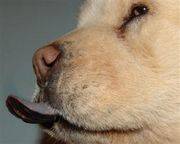
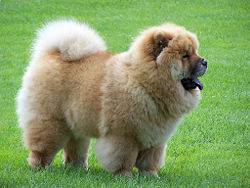
The other animal that has a blue tongue is the Chow Chow dog (or Chow).
The Chow is a sturdily built dog that is square in profile with broad skull and small, triangular, erect ears that are rounded at the tip. It has a very dense double coat that is either smooth or rough. Its fur is particularly thick around the neck, forming a sort of mane. The fur may be one of five colors including red, black, blue, cinnamon, and cream. Their eyes should be deep set and almond in shape. Chows are distinguished by their very straight hind legs and their blue-black/purple tongue. The Chow’s lips are also blue. One other distinctive feature is their tail, which has thick hair and lies curled on its back.
Another animal that has a blue tongue is the giraffe.
Giraffe’s have long (46 centimeter or 18 inch), blue-black tongues that allow them to maneuver around the long thorns of the acacia trees in order to reach the leaves on which they feed.
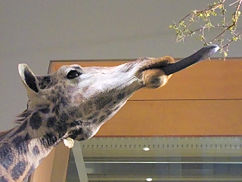
The following video shows how useful a giraffe’s tongue is.
Try the free Mathway calculator and
problem solver below to practice various math topics. Try the given examples, or type in your own
problem and check your answer with the step-by-step explanations.

We welcome your feedback, comments and questions about this site or page. Please submit your feedback or enquiries via our Feedback page.