Animal Facts - Flying Fish
In this page we will look at the amazing Flying Fish.
If you have any interesting or funny facts about animals or would like to find out more information about a particular animal, please fill up the Feedback form and we will be happy to add it to our list of animal facts.
Can fish fly?
The Exocoetidae or Flying Fish look like they are flying, but they are actually gliding through the air. They have unusually large pectoral fins that enable them to take short gliding flights through air, above the surface of the water, in order to escape from predators.
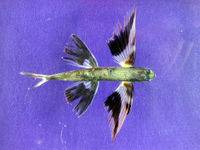
To prepare for a glide, the fish swim rapidly close to the surface of the water, with their fins close to the body. As they leave the water, they spread their fins and rapidly propel themselves forward with their tails. Eventually, even the tail leaves the water and the fish are airborne. They can even flap their “wings”. In gliding, flying fish can almost double their speed, reaching speeds up to 60 km/h. The glides are usually up to 30-50 meters in length, but some have been observed soaring for hundreds of meters using the updraft on the leading edges of waves. The fish can also make a series of glides, each time dipping the tail into the water to produce forward thrust.
They are found in all the major oceans, particularly in the warm tropical and subtropical waters of the Atlantic, Pacific, and Indian oceans. Flying fish live close to the water surface and feed on plankton.
The following video shows a fish “flying” for about 45 seconds.
Try the free Mathway calculator and
problem solver below to practice various math topics. Try the given examples, or type in your own
problem and check your answer with the step-by-step explanations.

We welcome your feedback, comments and questions about this site or page. Please submit your feedback or enquiries via our Feedback page.