Angles of Polygons
Related Topics:
More Lessons for High School Geometry
Math Worksheets
A series of free, online High School Geometry Video Lessons and solutions.
Examples, solutions, videos, worksheets, and activities to help Geometry students.
In this lesson, we will learn
- how to find the sum of interior angles of a polygon
- how to calculate the measure of a single angle of a regular polygon
- how to find the sum of the exterior angles in a polygon
- how to find the measure of one exterior angle in a regular polygon
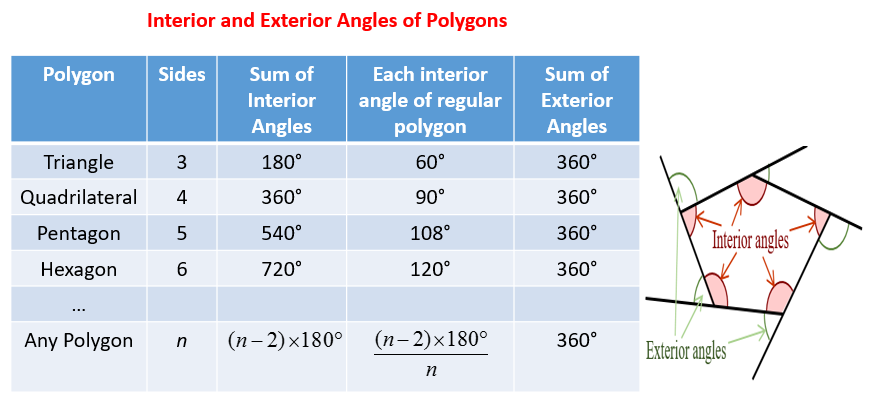
The following table gives the formulas for the sum of the interior angles of a polygon and the sum of exterior angles of a polygon. Scroll down the page if you need more examples and solutions.
Sum of Polygon Angles
The sum of the angles in any polygon is equal to the number of sides in the polygon minus two, all multiplied by 180 degrees. Sum of polygon angles problems may ask you to determine the sum of angles in a particular type of polygon, the number of sides when given the sum of polygon angles, or a particular angle given the other angles in the polygon.
How to find the interior angle sum of a polygon?
Equiangular Polygon Sums
The sum of the angles in a polygon is always equal to the number of sides in a polygon minus two, all multiplied by 180. Since the angles in an equiangular polygon are equal, the measure of one angle in any equiangular or regular polygon is simply the sum of polygon angles divided by the number of angles in the polygon. Knowing this information allows us to solve polygon problems with missing angle measurements.
How to find the measure of one angle in any equiangular or regular polygon.
How to find the sum of the interior angles and how to calculate the measure of a single angle of a regular polygon?
Exterior Angles of a Polygon
In a polygon, an exterior angle is formed by a side and an extension of an adjacent side. Exterior angles of a polygon have several unique properties. The sum of exterior angles in a polygon is always equal to 360 degrees. Therefore, for all equiangular polygons, the measure of one exterior angle is equal to 360 divided by the number of sides in the polygon.
How to find the sum of the exterior angles in a polygon and find the measure of one exterior angle in an equiangular polygon.
How to find the measure of an exterior angle of a regular polygon?
Try the free Mathway calculator and
problem solver below to practice various math topics. Try the given examples, or type in your own
problem and check your answer with the step-by-step explanations.

We welcome your feedback, comments and questions about this site or page. Please submit your feedback or enquiries via our Feedback page.